
Narrated Abu Huraira:
The Prophet said, “When it is a Friday, the angels stand at the gate of the mosque and keep on writing the names of the persons coming to the mosque in succession according to their arrivals. The example of the one who enters the mosque in the earliest hour is that of one offering a camel (in sacrifice).
The one coming next is like one offering a cow and then a ram and then a chicken and then an egg respectively. When the Imam comes out (for Jumua prayer) they (i.e. angels) fold their papers and listen to the Khutba.”
(Sahih Bukhari)
O you who believe! When the call is proclaimed to prayer on Friday, then proceed to the remembrance of Allah and leave trade. That is better for you, if you only knew.
And when the prayer has been concluded, disperse within the land and seek from the bounty of Allah , and remember Allah often that you may succeed.
(Qur'an, 62: 9-10)
The bigger you want your reward to be, the more you gotta work for it. Eggs don’t weigh much, you know. And what do you think about those who reach the masjid after the Imaam comes out? Even angels leave their jobs at that time to listen to the khutbah!
By Inspiring Stories
On the authority of Abu Hurayrah (may Allah be pleased with him) from the Prophet (peace and blessings of Allah be upon him), who said:
"A prayer performed by someone who has not recited the Essence of the Qur'an (Surah Fatiha) during it is deficient (and he repeated the word three times), incomplete."
Someone asked Abu Hurayrah: [Even though] we are behind the imam? (listening to him reciting al-Fatihah)
He said: Recite it to yourself, for I have heard the Prophet ( صَلَّى اللَّهُ عَلَيْهِ وَسَلَّمَ) say:
"Allah (mighty and sublime be He), had said: 'I have divided prayer between Myself and My servant into two halves, and My servant shall have what he has asked for.
When the servant says: الْحَمْدُ لِلَّهِ رَبِّ الْعَالَمِينَ
"Praise be to ALLAH, Lord of the Worlds.",
Allah Ta'ala says:
'My servant has praised Me.'
And when he says: الرَّحْمَنِ الرَّحِيمِ
"The Merciful, the Compassionate."
Allah Ta'ala says: 'My servant has adorned Me,'
and when he says: مَالِكِ يَوْمِ الدِّينِ
"Master of the Day of Judgement."
Allah says: 'My servant has glorified Me' - and on one occasion He said: 'My servant has submitted to My power.'
And when he says: إِيَّاكَ نَعْبُدُ وَإِيَّاكَ نَسْتَعِينُ
"It is You we worship and it is You we ask for help."
He (Allah) says: 'This is between Me and My servant, and My servant shall have what he has asked for.'
And when he says: اهْدِنَا الصِّرَاطَ الْمُسْتَقِيمَ صِرَاطَ الَّذِينَ أَنْعَمْتَ عَلَيْهِمْ غَيْرِ الْمَغْضُوبِ عَلَيْهِمْ وَلَا الضَّالِّينَ
"Guide us to the straight path, the path of those upon whom You have bestowed favors, not of those against whom You are angry, nor of those who are astray."
He (Allah Ta'ala) says: 'This is for My servant, and My servant shall have what he has asked for.'"
[Muslim (also by Malik, at-Tirmidhi, Abu-Dawud, an-Nasa'i and Ibn Majah)]
Listen the beautiful racitation of Surah Al-Fatiha by Saad Al-Quraishi from here.
By Inspiring Stories
Suhayb ibn Sinan, reported that the Messenger of Allah (pbuh) told:
“There lived a king (Yusuf Dhu Nuwas ) before you (in Yemen and he lived about 70 years before the birth of Messenger of Allah PBUH) and he had a magician.
As the magician grew old, he said to the king:
"I have become old and my time is nearly over, so send me a boy whom I can teach magic.''
So, he sent him a boy (Abdullah Ibn Tamir) and the magician taught him a magic. On his way (to the magician) the young man found a monk sitting there and listened to his talk and was impressed by it. It became his habit that on his way to the magician he met the monk set there so he was late in coming to the magician who beat him because of the delay.
The young boy made a complaint about it to the monk so the monk said,
“When you feel afraid of the magician, say, ‘My people kept me busy.’
And when you feel afraid of your family say to them: “The magician kept me busy.”
It once happened that there came a huge beast (of prey) and it blocked the way of the people. The young boy said,
“I shall find out today whether the magician or the monk is correct (in believe).”
He picked up a stone and said,
“O Allah, if the teaching of the monk are dearer to You than the teaching of the magician, bring death to this animal so that the people will be able to move about freely.”
He threw that stone towards it and killed it and the people began to move about (on the path freely).
The young man then came to that monk and informed him. The monk said,
“My son, today you are superior to me. Your affairs have reached a stage where I find that you will soon be put to the test, and in that case don't reveal my identity.”
The young man began to treat the blind and those suffering from leprosy and began to cure people of (all kinds) of illness. There was a courtier of the king who had become blind and he heard about the boy. He came and brought a number of gifts for the boy and said,
“If you cure me, all these things collected together here will be yours.”
He said, ”I myself do not cure anyone; it is Allah Who cures. If you affirm faith in Allah, I shall also supplicate Allah to cure you.”
He affirmed his faith in Allah and Allah cured him. He came to the king and sat by his side as he used to sit before. The king said to him, “Who restored your eyesight?” He said, “My Lord.” The king then asked, "I did?'' The courtier said, "No, my Lord and your Lord - Allah''
The king said, "Do you have another Lord beside me'' He said, "Yes, your Lord and my Lord is Allah.'' Whereupon the king took hold of him and tortured him until he revealed the identity of boy.
The young man was thus summoned and the king said to him, “O boy, it has been conveyed to me that you have become so talented in your magic that you cure the blind and those suffering from leprosy and you do such-and-such things.”
Thereupon he said, “I do not cure anyone; it is Allah Who cures.”
The king took hold of him and began to torture him. So he revealed the identity of the monk. The monk was thus summoned and it was said to him, “Turn back from your religion.” He, however, refused to do so.
King (ordered) a saw to be brought and it was placed in the middle of his head and it fell apart. Then the courtier of the king was brought and it was said to him, “Turn back from your religion but he refused to do so.” Then the same was done with him as well.”
Then the young boy was brought and it was said to him, “Turn back from your religion.” He refused to do so and he was handed over to a group of his courtier. He said to them, “Take him to such and such mountain; make him climb that mountain and when you reach its top (ask him to give up his faith) but if he refuses to do so, throw him down the mountain.”
So they took him and made him climb the mountain. The boy prayed,
“O Allah, save me from them (in any way) You will.” The mountain began to quake and they all fell down, the boy came walking back to the king. The king said to him, “What has happened to your companions?” He said, “Allah has saved me from them.”
He again handed him to some of his courtiers and said, “Take him and carry him away in a small boat and when you reach the middle of the ocean ask him to give up his religion, but if he does not give up his religion throw him (into the water).' So they took him and the boy prayed,
“O Allah, save me from them and what they want to do.” It was not long before the boat overturned and they were drowned but he came walking back to the king.
The king said to him, '”What has happened to your companions?” He said, “Allah has saved me from them.” He also said to the king, “You cannot kill me until I tell you how to do.”
He asked, “What is that?” The boy said, “You should gather people on a plain and hang me by the trunk (of a tree). Then take an arrow from the quiver and say, “In the name of Allah, the Lord of the worlds;” then shoot an arrow. If you do that, you would be able to kill me.'
So he did this and placing an arrow in the bow, he shot it, saying, (bismillahi Rabbi) “In the name of Allah, the Lord of the young boy;” The arrow hit the boy in the temple, and the boy placed his hand over the arrow wound and died.
The people proclaimed, “We affirm our faith in the Lord of this young man”
The courtiers came to the king and it was said to him, “Do you see what has happened that which you feared has taken place. That their faith is in the Lord”
So he ordered that ditches to be dug at the entrances to the roads and it was done, and fires were kindled in them. Then the king said,
"Whoever abandons his religion, let him go, and whoever does not, throw him into the fire.''
(The people courted death but did not refused their faith from Allah) untill a woman came with her baby whom she was breast feeding, she felt hesitant about jumping into the fire, the baby spoke to her, "Be patient mother! For verily, you are following the truth!''
[Muslim and Imam Ahmad recorded it]
According to some reports, about more than twelve thousand people were burned into ashes. After that the fire flared up so high that it spread out wildly through the city and burned all those who were watching the fun of burning the Muslims. Only Yusuf Dhu Nuwas (the king) managed to run away, and threw himself into the sea in order to save himself from the rage of the fire, but he got drowned and died. [Tafsir Mazhari]
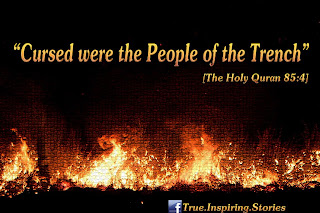
It was about Dhu Nowas and his army that Allah revealed to His Messenger (PBUH) In Surah no. 85 Al-Buruj, the reference is made to this incident.
THE HOLY QURAN:
“Cursed were the People of the Trench, the (people of the) fire that was rich with fuel, when they were sitting by it, and were watching what they were doing with the believers. And they had blamed them for nothing but that they believed in Allah, the All-Mighty, the Worthy of All Praise, the One to whom belongs the kingdom of the heavens and the earth. And Allah is witness over every thing. Surely, those who persecuted the believing men and the believing women, then did not repent, for them there is the torment of Jahannam (Hell), and for them there is the torment of burning.” [85: 4-10]
In a narration of Muhammad Ibn Ishaq, it is reported that the place where the boy Abdulluh Ibn Tamir was buried had to be dug up for some important reason during the time of Sayyidna Umar (RA). It was found that the body of 'Abdulluh Ibn Tamir was unharmed, and he was sitting up. His hand was placed on his hip joint, where the arrow struck him. Someone people moved his hand out from that place, and his wound started bleeding. When the hand was placed back in its position, the bleeding stopped.
There was a ring in his finger which had the inscription: (Allahu Rabbi) "Allah is my Lord." The governor of Yemen informed Sayyidna Umar (RA) about this, and he wrote back in reply: "cover the body back as it was with his finger-ring." [Tafsir Ibn Kathir]
By Inspiring Stories
------------------------------------------------
The Jews were used to give ever-new excuses for denying the Holy Prophet (pbuh). When they came to know that it was Archangel Jibra'el (Gabriel) who brought the Glorious Quran to the Holy Prophet (pbuh), then they said that Jibra’el was their enemy, as it was through him that exact commandments or terrible punishments had always descended on them, and for this reason they would not accept a Book which had been revealed through his action. They also added that they could have accepted the Holy Quran, if the Archangel Mika'il (Michael) had brought it down, for he is connected with rain and with divine mercy.
To deny it on account of one’s hostility to Jibra'el (A.S) is sheer stupidity. Now, as for the attitude of the Jews towards Jibra’el (A.S), the Holy Quran declares that to be hostile to the angels or to the prophets is equal to being hostile to Allah Himself. In other words, those who deny or oppose the angels and the prophets will have their due punishment in the other world. Thus for this reason the following verses from Surah Al Baqarah was revealed:
“Say (O Muhammad), whoever be an enemy to Jibra'el (Gabriel) -- it is he who has brought it down upon your heart by the permission of Allah, confirming what has been before it, and a guidance and good tidings to the believers.
Whoever be an enemy to Allah, His angels, and His Messengers, and to Jibra'el and Mika'il, then surely Allah is enemy to the disbelievers.”
(Quran 02: 97-98)
(Tafsir Ma’ariful Quran, vol 1)
By Inspiring Stories------------------------------------------------------
The following incident is mentioned in Surah Al-Feel of the Holy Quran and it happened during the period of the birth-year of Prophet Muhammad (peace be upon him).
Abraha Al-Ashram was the governor of Yemen on behalf of the king of Ethiopia. He thought to build a house (like the Kabah at Makkah) in Sana (the capital of Yemen) and call the Arabs to perform the pilgrimage there in Sana instead of the Kabah in Makkah, with the intention of diverting the trade and benefits from Makkah to Yemen. He presented his idea to the king of Ethiopia who agreed to it.
So the house (church) was built and he named it Al-Qullais; there was no church of its like at that time. Then a man from the Quraish tribe of Makkah came there and was infuriated by it, so he relieved his nature (stools and urine) in it, soiled its walls and went away.
When Abrahah Al-Ashram saw that, he could not control his anger and raised an army to attack Makkah and demolish the Kabah. He had in that army thirteen elephants and amongst them was an elephant called ‘Mahmud’ which was the biggest of them.
Abraha's elephant is supposed to have refused to cross the boundary of Mecca and sat down. The accounts state that if the elephant was turned towards Syria or Yemen it would walk without hesitation, but when it was turned towards the Kabah it would kneel on its knees as if it would adore the city that its master was targeted on destroying.
Abdul Muttalib ordered the men of Makkah to leave the city and go to the top of the mountains along with their wives and children in case some harm should come to them from the invading oppressors.
On the way to Makkah, the army of Abraha destroyed everything in their way and stole hundreds of camels. Amongst them were some camels that belonged to Abdul Muttalib who was the grandfather of Prophet Muhammad (pbuh).
Abdul Muttalib knew that Abraha was coming to destroy the Kabah. He ran towards the Kabah and prayed to Allah.
"O Allah! Save Your house and do not let them destroy it!"
Then he went to Abraha. And Abraha asked him: "Why do you wish to see me?"
Abdul Muttalib said he wanted his camels back.
Abraha was shocked and said: "I have come to destroy the Kabah. You are the chief of Makkah and the guardian of the Kabah and all you are worried about is your camels!?" Abdul Muttalib replied : "The camels belong to me, and so I ask for their return. The Kabah belongs to Allah and He will look after it Himself"
When Abraha heard this he returned the camels and marched forward to destroy the Kabah. Allah sent a flock of birds who flew over the army pelting them with small stones of baked clay which killed the elephants and the soldiers.
All except Abraha were destroyed and he rushed back toYemen to tell the King what had happened. He was followed by one of the birds. Abraha looked up and showed him. "What sort of amazing birds were these!" asked the furious King. The bird threw a stone and Abraha died on the spot in front of the King.
The Holy Quran, Surah Feel 105 (The Elephant):
[105:1] Have you (O Muhammad (Peace be upon him)) not seen how your Lord dealt with the Owners of the Elephant?
[105:2] Did He not put their plan into ruin?
[105:3] And sent flocks of birds upon them
[105:4] Which hit them with Sijjeel (stones of baked clay),
[105:5] So He made them like the leftover devour leaves of farms.
By Inspiring Stories
When the Samanid ruler, Nasr bin Ahmad ( 301 - 331 A.H), entered Nishapur, he held a court. After ascending the throne, he wanted the proceedings to be started with the recitation from the Holy Qur'an. At this an elderly pious man came forward and recited a section of the Surah Al- Mu'min. When he came to the verse (On that Day it will be asked:) "...Whose is the Kingdom today?" (40:16)
Nasr was struck with awe; he descended the throne trembling, took off the crown and fell down in prostration, saying: "O my Lord, Kingdom is Yours, not mine!"
---------
The Holy Quran, in Surah Al-Mu'min:
The Day when they will come out, nothing of them will be hidden from Allah.
(it will be asked) Whose is the Kingdom today? It is Allah's, the One, the Mighty!
Today everyone will be recompensed for what he earned. There is no injustice today.
Truly, Allah is swift in reckoning. (40:16-17):
Tafsir:
According to a hadith reported by Abu Wa'il from Sayyidna Abdulluh Ibn Mas'ud, all human beings will be assembled together on a clear surface, a surface on which no sin would have been committed by anyone. At that time, a bearer of news will be commanded to ask: “To whom belongs the Kingdom today?” Thereupon, the entire creation, believer or disbeliever, will respond saying: “To Allah alone, the One, the All Dominant.”
As for the believers, they will be more than pleased to say so, for this would be part of their belief. As for the disbelievers, they will confess to it sadly and helplessly.
And some other narrations (ahadith) also show that Allah Taala will make this statement when the entire creation will be destroyed after the blowing of the first Horn, and when even specially close ones, the angels (Jibrael, Mikael, Israfeel and the angel of death Izrael) will also meet death, and no one except the One Being of Allah Subhanahu wa Taala will remain, that will be the time He will say: “To whom belongs the Kingdom today?” Since there will be no one to answer at that time, He will Himself answer: “To Allah alone, the One, the All-Dominant.”
It is supported by the Hadith of Sayyidna Abu Hurairah and Ibn Umar (RA) in which it is said, “On the Day of Judgment, Allah Taala will with all earth surfaces rolled up in His left hand and all heavens rolled up in His right hand will say: “I am the owner of the kingdom. Where are the tyrants? Where are the arrogant?”
(Tafsir Maariful Quran, Vol 8)
By Inspiring Stories
“And of the people are some who say, “We believe in Allah and the Last Day, ”but they are not believers.They [think to deceive] Allah and those who believe, but they deceive not except themselves and perceive [it] not. In their hearts is disease, so Allah has increased their disease; and for them is a painful punishment because they [habitually] used to lie.”
[Al-Qur'an - Surah Baqrah - 2:8-10]

It is narrated by Mahmud bin Labid (r.a), Allah's Messenger (pbuh) said: "The most dreadful thing which I fear about you is minor (shirk) polytheism."
The companions (r.a) asked: "What is the minor (shirk) polytheism?"
He (pbuh) said: "It is hypocrisy; and he (pbuh) added that on the Day of Judgment, when rewarding people for their deeds, Allah (s.w.t) will say to the hypocrites: 'Go to those for the sake of whom you used to perform good deeds; and see whether you can get any reward from them.'"
(Musnad Ahmad)
"O Allah! Purify my heart of hypocrisy, and my deeds from showing off, and my tongue from lying, and my eyes from betraying trust (looking at the forbidden). For indeed, You know what the eyes betray, and what is hidden deep in the breasts."
(Baihaqi)
------------------------
1. إِنَّا لِلّهِ وَإِنَّـا إِلَيْهِ رَاجِعونَ "We belong to Allah and to Him we are to return"
This is what the patient people should say as it brings excellent reward, relieves from the burden of sorrow and suffering and consoles effectively the grieved heart.
As the quality and degree of patience varies from person to person, everyone will be rewarded individually according to and commensurate with his quality of patience.
2. O you who have believed, seek help through patience and prayer. Indeed, Allah is with the patient ones. [2:153]
3. Let us not forget that, according to the Hadith,
whenever the Holy Prophet (pbuh) was faced with a grave problem of any kind, he always hastened to offer nafl prayers, and through the barakah (benediction) of the prayers, Allah came to his aid and resolved the problem satisfactorily.
4. "Say, 'only what Allah has decreed for us will happen to us. He is our Master: let the believers put their trust in Allah" (Qur'an 9:51)
And surely We will test you with a bit of fear and hunger, and loss in wealth and lives and fruits.
And give good tidings to the patient who, when suffering comes to them, say: 'We certainly belong to Allah, and to Him we are bound to return!'
Those are the ones upon whom there are blessings from their Lord, and mercy. And those are the ones who are on the right path. (Quran 2:154-157)
“For truly with hardship comes ease” (Quran 94:5-6)
Bear sorrows and calamities patiently otherwise you will never be happy.
-Hazrat Ali (R.A)
"For every dark night, there's a brighter day"
-Tupac Shakur


+of+mountain_top_cast.jpg)


